How to Verify Commercial Cleaning Insurance in NSW
Learn how to verify commercial cleaning insurance in NSW, check certificates of currency, review policy limits and identify coverage gaps before work begins.
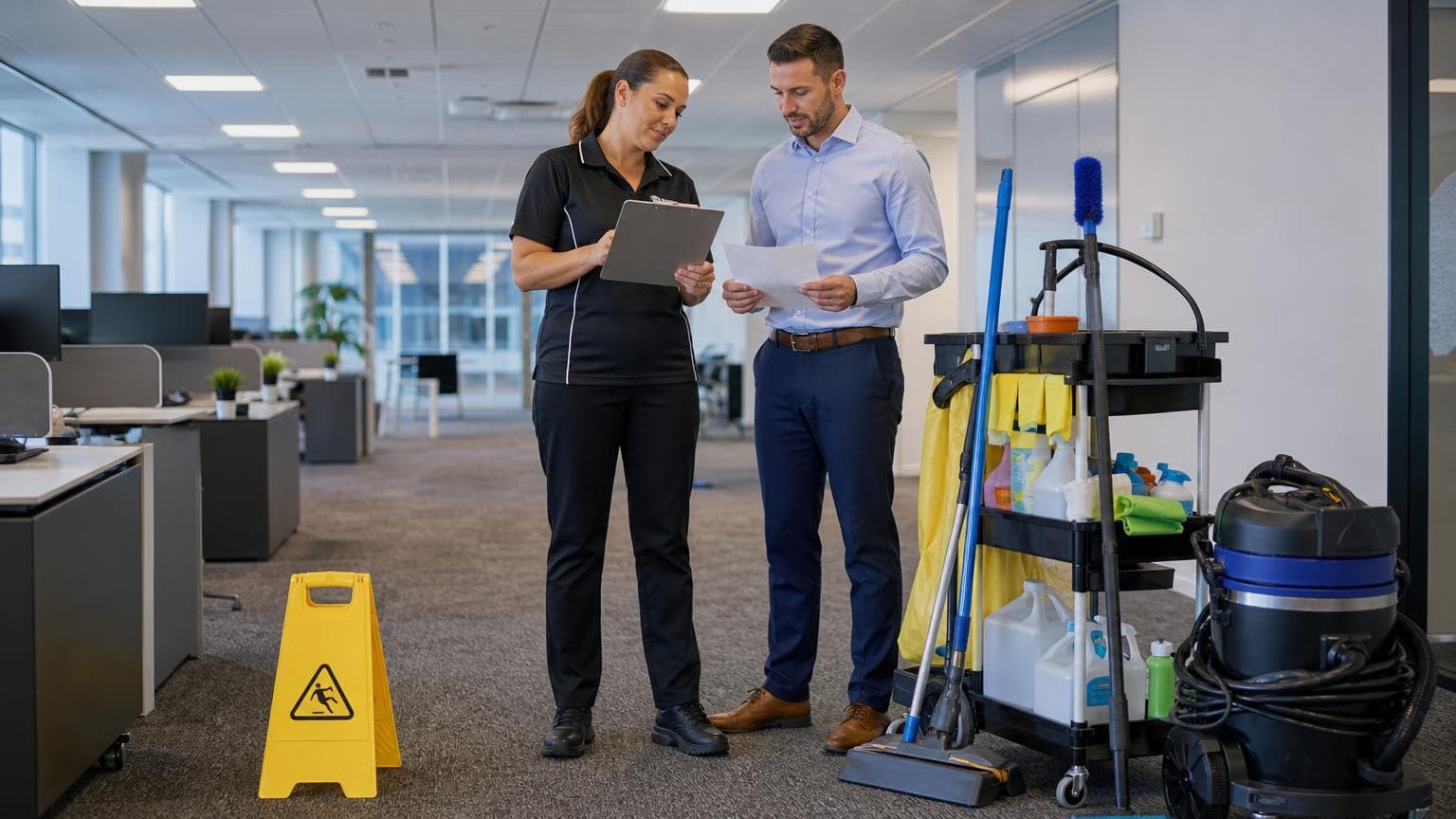
Before a cleaning contractor enters your workplace, verify their insurance rather than relying on a proposal, website statement or verbal assurance. The right documents help you understand whether the contractor can respond to common risks such as property damage, personal injury, chemical incidents and accidents involving workers.
This guide explains how to verify commercial cleaning insurance in NSW, with a focus on certificates of currency, policy limits and coverage gaps. It is designed for businesses, schools, medical facilities, warehouses, strata properties and other organisations appointing a cleaning provider.
Why insurance verification matters before cleaning starts
Commercial cleaning involves more than vacuuming and wiping surfaces. Contractors may use ladders, powered equipment, cleaning chemicals, pressure washers and floor machines. They may also work around visitors, employees, stock, sensitive equipment and valuable finishes.
Insurance does not remove every risk, and a certificate of currency is not the same as a guarantee that every incident will be covered. However, checking the documents before work begins can reveal whether the contractor has relevant policies in place and whether the proposed work appears to fit within the insured activities.
Insurance verification should sit alongside a written scope of work, site induction, risk assessment and service agreement. For more background on supplier checks, see our guide to how to vet a commercial cleaner in NSW.
What is a certificate of currency?
A certificate of currency is a document issued by an insurer or insurance broker that confirms a policy is current at the date shown. It commonly identifies the insured business, policy type, policy period and level of cover. It may also include the insurer or broker’s contact details and special notes about the policy.
When you receive a certificate, check that it belongs to the legal entity you are engaging. A trading name alone may not be enough to confirm that the contracting entity is insured. Compare the business name and any relevant Australian Business Number details with the entity named in the contract or quotation.
Ask for an updated certificate if the document is expired, unclear, addressed to another customer or missing important information. You should also request confirmation if the certificate does not clearly describe the activities the contractor will perform.
How to check commercial cleaning insurance in NSW
1. Request the documents directly
Ask the proposed cleaning company for current certificates of currency before approving access to the site. Depending on the work, you may need evidence of several policies rather than one general document.
- Public liability insurance for third-party injury or property damage risks.
- Workers compensation insurance where the business employs workers who will perform the cleaning.
- Motor vehicle insurance for vehicles used in connection with the service, where relevant.
- Professional indemnity insurance if the contractor provides advice, compliance-related services or other professional work beyond routine cleaning.
- Any additional cover required by your lease, client contract, site rules or risk profile.
Not every contractor will need every type of policy. The appropriate cover depends on the services, business structure, workforce and site conditions. If the work includes construction cleaning, high-pressure cleaning, solar panel cleaning or specialist surfaces, ask how those activities are treated under the relevant policy.
2. Check the insured name and policy dates
Confirm that the named insured matches the company you are engaging and that the policy period covers the planned service dates. A certificate that was valid during a previous tender or contract period may no longer be current.
For an ongoing cleaning arrangement, include a requirement for updated certificates when policies renew. You can also record the expiry dates in your supplier register and follow up before the next renewal is due. This is a practical administrative check, not a substitute for professional insurance advice.
3. Review the policy type and business activities
Look for wording that relates to cleaning services or the actual work being proposed. A contractor may carry public liability insurance, but that does not automatically confirm that every specialist activity is included.
Ask specific questions about the planned work, including chemical use, carpet extraction, pressure washing, external window cleaning, elevated work, construction site cleaning and solar panel cleaning. If the certificate is brief, ask the contractor or broker to confirm in writing that the policy responds to the relevant activities.
For a clearer understanding of specialist cleaning tasks, review our specialised cleaning services for carpet, pressure and solar work in NSW. The more accurately the scope is described, the easier it is to identify questions about insurance and site controls.
4. Assess the policy limits
The policy limit is the maximum amount an insurer may pay for a covered claim, subject to the policy terms, exclusions, conditions and any applicable sublimits. Do not assess the limit in isolation. Consider the value of the building, equipment, stock and operations that could be affected by the cleaning activity.
Ask whether the stated limit applies per occurrence, in total for the policy period or under another structure. Check whether separate sublimits apply to areas such as property in care, custody or control, underground services, damage to rented premises or pollution-related incidents. These details can materially affect how a claim is handled.
Your organisation may have procurement or lease requirements that specify minimum limits. If so, provide those requirements to the contractor before work starts and ask for evidence that the policy meets them. If there is no prescribed limit, your broker, insurer, facilities manager or legal adviser can help assess an appropriate level for the site.
5. Check for coverage gaps
A coverage gap occurs when the work, party or property at risk falls outside the policy or is restricted by an exclusion, condition or sublimit. Common questions for commercial cleaning arrangements include:
- Is damage to property being cleaned or worked on treated differently from general third-party property damage?
- Are keys, access cards, alarm codes and unattended premises addressed by the policy conditions?
- Are chemicals, spills, contamination and accidental releases subject to exclusions or special requirements?
- Are ladders, elevated work, external windows and equipment use covered for the proposed method?
- Does the policy cover subcontractors, or must each subcontractor provide separate evidence?
- Are vehicles and mobile equipment insured for the way they will be used?
- Are there conditions requiring staff training, supervision, signage or safe storage of chemicals?
Do not assume that a certificate answers these questions. A certificate summarises cover and normally does not reproduce the full policy wording. Ask the contractor to obtain clarification from its insurer or broker where the risk is important to your site.
Workers compensation checks in NSW
If employees will attend your premises, ask how the contractor manages workers compensation obligations in NSW and request appropriate evidence. The document and verification process may differ according to the business structure and workforce arrangements.
Be cautious if a provider describes all cleaners as independent contractors without explaining the arrangement. Your organisation should not attempt to determine insurance or employment status from a label alone. Ask for relevant documentation and obtain advice from a qualified workplace relations, legal or insurance professional when the arrangement is unclear.
What to record in your cleaning agreement
Insurance checks are most useful when they are reflected in the contract. Your agreement can identify the services, work areas, equipment, chemicals, access arrangements and responsibilities of each party.
Consider including requirements that the contractor:
- Maintains insurance appropriate to the services throughout the contract.
- Provides current certificates of currency on request and at renewal.
- Notifies your organisation if a relevant policy is cancelled, altered or allowed to lapse.
- Uses trained workers and approved subcontractors where subcontracting is permitted.
- Reports incidents, near misses, property damage and chemical spills promptly.
- Complies with site procedures, inductions, permits and reasonable safety directions.
Set out the process for reporting damage and preserving evidence. Photographs, incident records, witness details, work orders and cleaning product information may help the relevant parties investigate an event. A well-defined service agreement should also explain quality standards and communication arrangements. Our NSW cleaning service level agreement guide covers practical contract considerations.
Red flags during an insurance review
Pause the appointment if a contractor refuses to provide documents, supplies an expired certificate, gives a certificate for a different legal entity or cannot explain whether the proposed work is insured. Other warning signs include pressure to start before verification, vague answers about subcontractors and claims that a certificate proves every possible risk is covered.
A missing document does not automatically prove that a business is uninsured. It does mean you need clarification before granting access or approving higher-risk work. For significant sites or specialist services, involve your insurance broker, facilities manager or legal adviser in the review.
Use insurance verification as part of contractor control
Verifying commercial cleaning insurance in NSW is a focused pre-start control. It should be repeated when the contract changes, the cleaning scope expands, a new subcontractor is introduced or a policy renews.
Combine the insurance review with a site-specific risk assessment, safe work procedures, chemical registers, equipment checks and service inspections. This creates a more complete approach to managing cleaning activities without treating insurance as the only protection.
Eco Spark Facility Services provides commercial, industrial and specialised cleaning services for organisations across Wagga Wagga, Estella and NSW. To discuss a documented cleaning program and the information needed before work begins, contact Eco Spark Facility Services through our commercial cleaning team.