Commercial Vinyl Floor Cleaning: Products and Methods
Commercial vinyl floor cleaning depends on the floor type, manufacturer instructions, soil and existing finish. This guide explains how to select products, control moisture, avoid unnecessary stripping and brief a cleaner for a commercial site.
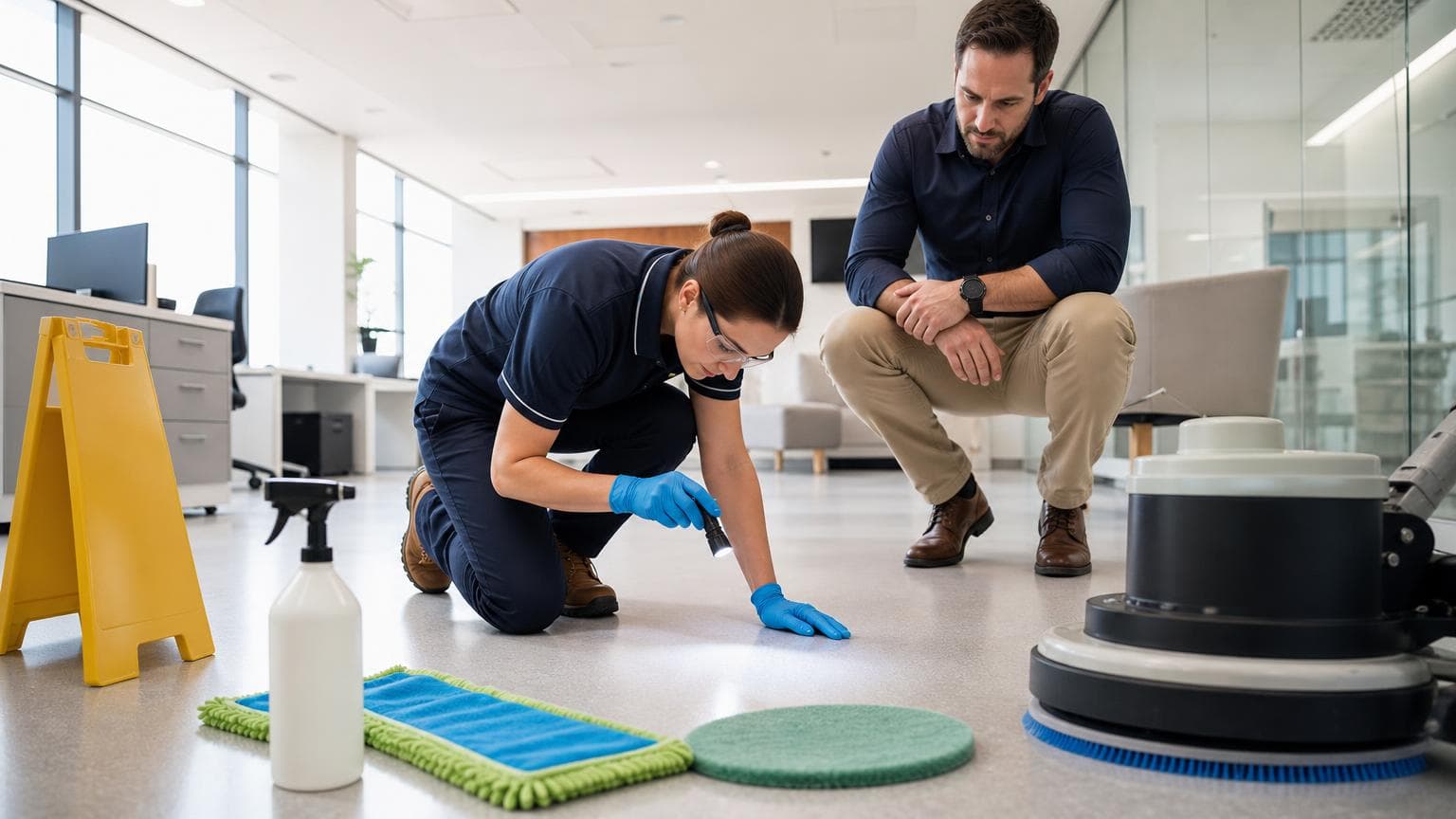
Commercial Vinyl Floor Cleaning: What Facility Managers Need to Know
Identify the material and its maintenance instructions first. VCT, sheet vinyl, luxury vinyl tile and luxury vinyl plank can differ in their finishes, seams and protective wear layers. Those differences determine whether routine cleaning, controlled agitation or finish removal is appropriate, so the strongest chemical is rarely the best starting point.
Most people begin by looking for the strongest chemical. That is backwards. A neutral cleaner may suit tracked-in soil, while residue, grease, a worn finish or damaged joins require a different response. Check the floor type, soil and manufacturer instructions before selecting a product or machine method.
Start with the floor, not the chemical
A planned service identifies the floor type, reads the care instructions, removes loose soil, follows the approved dilution, agitates with a suitable pad or brush, recovers the dirty solution and allows the floor to dry before reopening the area. The operator should not select a product simply because it sounds powerful.
The product manufacturer's instructions take priority. A cleaner suitable for resilient sheet vinyl may not suit a printed luxury vinyl plank, while aggressive stripping can remove a finish that the floor does not need replaced.
What a properly planned service includes
A commercial vinyl floor service should begin with a site assessment rather than an automatic machine scrub. The cleaner identifies the floor type, checks the finish, notes embedded soil and looks for loose edges, damaged joins, adhesive failure or moisture below the surface.
Eco Spark Facility Services provides commercial, industrial and specialised cleaning across Sydney, Greater Sydney, Wagga Wagga, Estella and Regional NSW. Its service scope includes floor machine scrubbing alongside carpet steam cleaning, high-pressure washing, builders cleaning, high dusting and solar panel cleaning. That broader capability helps when vinyl forms one part of an office, warehouse, school, healthcare or construction site clean.
For a site assessment, record the floor type, approximate area, access restrictions, current finish, heavy-use zones and areas that must remain open. These details determine the method, labour requirement and cleaning sequence. Floor area alone cannot determine a reliable quote because access, contamination and preparation also affect the work.
The cleaning sequence that limits risk
- Inspect the surface. Confirm whether the floor is sheet vinyl, vinyl composition tile, luxury vinyl tile or luxury vinyl plank. Check the existing finish and record damage that cleaning cannot repair.
- Remove loose soil. Dry vacuuming or dust removal comes first. Grit left on the floor can act as an abrasive during wet cleaning.
- Prepare the cleaning solution. Follow the product label and flooring manufacturer's instructions. Excess chemical can leave residue, while insufficient chemical may fail to suspend soil.
- Control the work area. Keep staff, visitors and vehicles away from wet sections. On active commercial sites, match the sequence to access and safety arrangements.
- Agitate the floor. A low-speed floor machine, auto-scrubber, mop or suitable brush may be appropriate. Match the equipment and pad to the surface and soil level.
- Recover the solution. Remove dirty water instead of allowing it to dry back onto the vinyl. This helps limit streaks and sticky residue.
- Inspect after drying. Check edges, entrances, corners and high-traffic routes. A dull appearance may indicate residue or a worn finish rather than more dirt.
Do not start with stripping because a floor looks dull. Stripping removes an existing finish and creates additional disruption, chemical use and recovery work. Use it only when inspection shows that routine cleaning and suitable maintenance will not restore the required condition.
Products that need careful selection
Do not use abrasive powders, harsh scouring pads, undiluted chemicals or products excluded by the flooring manufacturer. Avoid flooding the floor, especially around seams, joins and edges, where excess water can travel below the surface.
Bleach, solvent-based products and strong alkaline degreasers do not automatically belong in a vinyl maintenance programme. Their suitability depends on the flooring system, concentration, contact time and manufacturer's instructions. Never mix cleaning chemicals.
Another common mistake is using a pad designed to remove finish on a floor that only needs cleaning. The operator may create a temporary shine, but the treatment can wear the protective layer and increase future maintenance.
Luxury vinyl needs a lighter touch
Start with the product's care instructions, not a generic commercial floor schedule. Luxury vinyl usually contains a printed design layer and a protective wear layer, so abrasive treatment, excess moisture and unsuitable polish can affect its appearance or performance.
Remove dry grit first, then use a lightly damp mop or approved machine method with the correct neutral cleaner. Work in manageable sections, control the solution and remove residue before it dries. Use soft tools around edges and inspect joins instead of repeatedly increasing chemical strength.
Luxury vinyl does not automatically need polish or stripping. In many cases, the manufacturer's maintenance routine is the better choice. This advice will not repair lifted planks, damaged seams, subfloor moisture or failed adhesive, and it is not a substitute for flooring repair or moisture investigation.
What a commercial vinyl cleaner should achieve
A commercial vinyl cleaner should loosen soil, remain compatible with the floor and leave little residue after recovery. The practical test is whether the process produces a cleanable surface without creating a new finish or residue problem.
- Better soil removal: The cleaner suspends tracked-in dirt so mechanical action and recovery equipment can remove it.
- Less residue: Correct dilution reduces the sticky film that attracts more soil.
- Lower surface risk: A compatible product is less likely to interfere with the finish than an unsuitable degreaser or abrasive treatment.
- Clearer maintenance decisions: A clean inspection shows whether the floor needs routine care, restorative work or repair.
- Consistent site standards: A written product and method gives facility staff something specific to check.
Eco-friendly cleaning should describe product and method choices, not vague green claims. Eco Spark Facility Services uses eco-friendly product programmes and methods as part of its NSW commercial cleaning work, while matching the process to the floor and site requirements.
Match the product to the job
Product names vary, but facility managers can separate commercial vinyl cleaners by the job they perform.
| Cleaner type | Typical role | What to check |
|---|---|---|
| Neutral daily cleaner | Routine removal of tracked-in soil and light marks | pH range, dilution and flooring compatibility |
| Low- or moderate-alkaline cleaner | Heavier soil and grease in suitable areas | Contact time, rinsing requirements and finish compatibility |
| Spot cleaner | Local treatment of isolated marks | Whether active ingredients affect colour, print or wear layer |
| Finish remover | Removal of an old coating before an approved finish | Whether stripping is necessary and how disruption will be managed |
| Disinfectant cleaner | Cleaning and disinfection where the site procedure requires both | Required contact time, surface compatibility and the documented process |
The best cleaner is not the most concentrated option. Start with the least aggressive product that meets the soil and hygiene requirement, then increase treatment only when inspection supports it.
Prepare the site before the cleaner arrives
Preparation determines how much of the cleaning work reaches the vinyl. Remove movable items where the scope allows, identify areas needing restricted access and separate loose debris before applying liquid.
Tell the contractor about recent polish, adhesive residue, construction dust, oil contamination, water damage and previous chemical treatment. A construction clean, warehouse floor and medical centre may all contain vinyl, but they present different soil and access conditions.
Record the product, dilution, equipment, pad or brush, treated area and defects reported. These records give the next operator a clear starting point and help facility managers distinguish cleaning issues from flooring faults.
Maintain the result between services
Routine maintenance should remove grit before it travels across the floor. Prioritise dry soil removal at entrances and high-traffic routes, clean spills promptly and use damp cleaning with the approved product instead of repeatedly flooding the area.
Inspect the floor after cleaning under normal lighting. If dull patches remain, check for residue, scratches, worn finish or differences in the vinyl before booking a more aggressive treatment. A machine cannot correct a damaged wear layer.
For properties changing occupants, vinyl cleaning may form part of a wider handover scope. End-of-lease cleans succeed when the checklist matches the property manager's inspection standard, not a generic domestic clean. Related planning may include end-of-lease cleaning in Wagga Wagga.
Plan around the actual service location
Eco Spark Facility Services is positioned for commercial, industrial and specialised cleaning across Wagga Wagga and New South Wales, including Sydney, Greater Sydney, Estella and Regional NSW. The service location matters because travel, access, operating hours and the surrounding cleaning scope affect planning.
Facility managers can review the broader commercial cleaning services offering or the commercial and industrial cleaning service when vinyl forms part of a larger programme. For a Wagga Wagga site, the commercial cleaning Wagga Wagga page provides a more direct starting point.
Vinyl floors may also sit alongside carpet, external surfaces or solar equipment. Eco Spark Facility Services lists those capabilities through specialised cleaning services, but the final scope should still separate each surface, method and access requirement.
Give the cleaner the right brief
Gather the floor type if known, approximate area, photographs, current condition, preferred service window and manufacturer care instructions. Ask the contractor to state the proposed cleaner, mechanical method, recovery process, preparation requirements and whether stripping is recommended.
Eco Spark Facility Services is a NSW commercial cleaning contractor with eco-friendly product programmes, industrial and construction cleaning experience, and insured team messaging on site. To plan commercial vinyl floor cleaning for a facility in Sydney, Greater Sydney, Wagga Wagga, Estella or Regional NSW, request a quote with the site details and floor information available.
Author: Eco Spark Facility Services