Which Commercial Office Vacuum Fits Your Cleaning Route?
The right commercial office vacuum depends on the cleaning route, not a headline suction claim. Compare backpack, upright and canister options against desk density, floor changes, power access and the areas that must be reached.
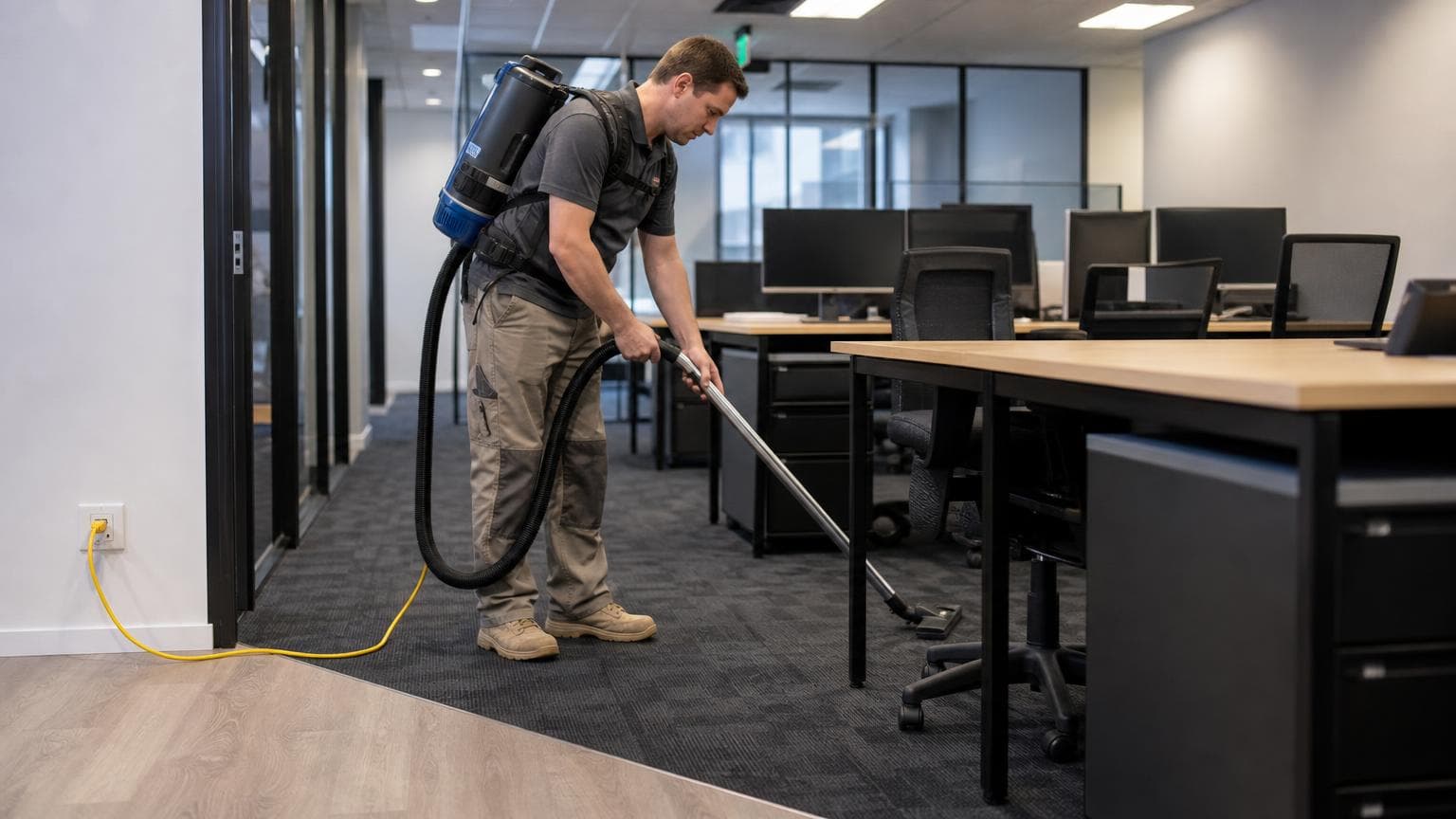
Choose a commercial office vacuum for the cleaning route
Choose by route, not headline suction. For most desk-heavy offices, a corded backpack is the better starting point because its hose and floor tool can work around desk legs, chair bases and meeting-room furniture; reserve an upright for long, clear carpet lanes. Before buying, run the floor head beneath the lowest desk, around a chair base, through storage doorways and across each carpet-to-hard-floor transition during the planned cleaning window. Mark stairs and power points too. Those route constraints, not suction claims, determine whether the machine can complete the work.
Make the route decide the vacuum type
| Rank | Vacuum type | Best starting point | What you gain | What you give up |
|---|---|---|---|---|
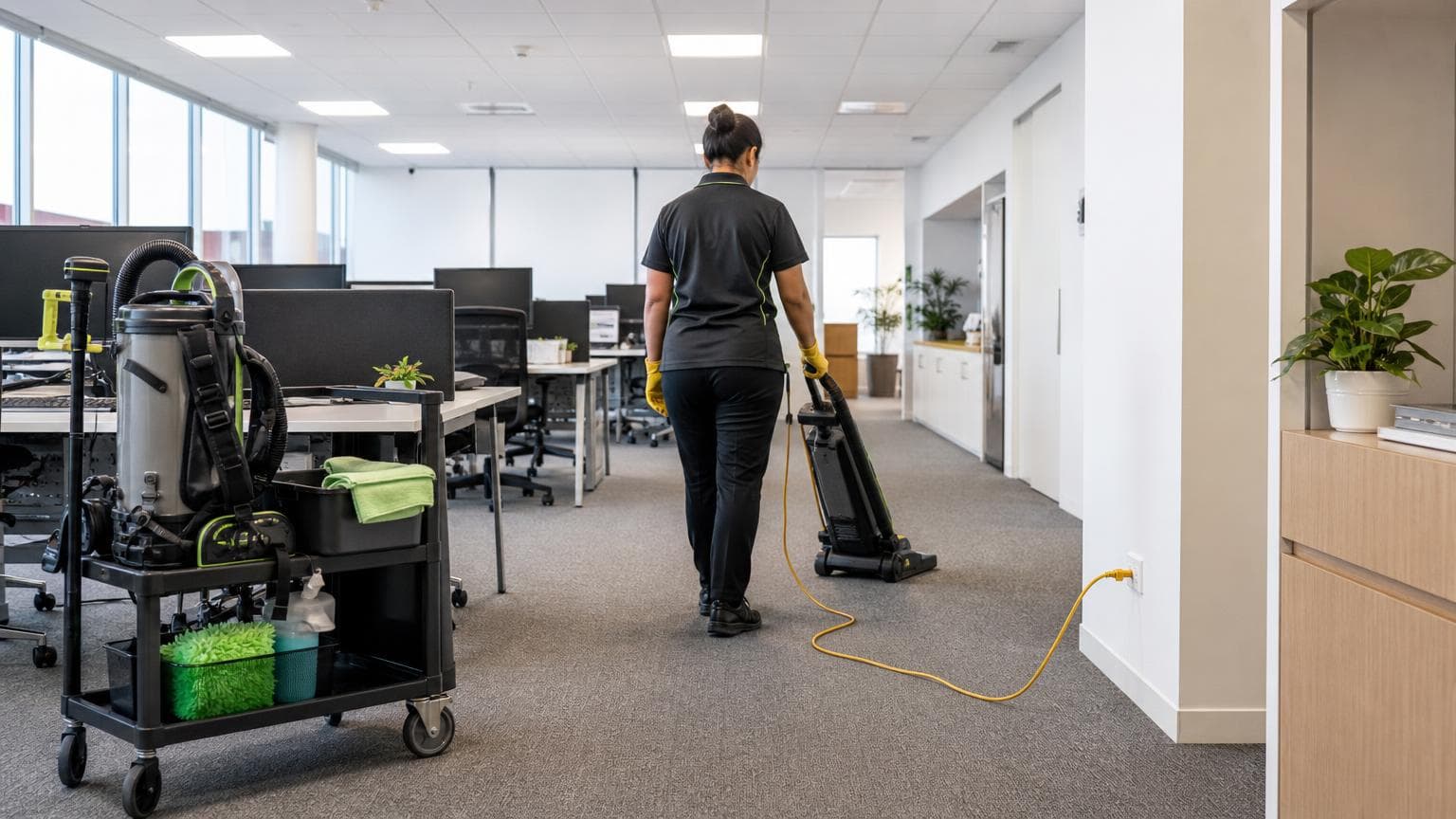
| 1 | Corded backpack | Desk-heavy offices, meeting rooms and tight chair layouts | Mobility around obstacles and reach in confined areas | The cleaner carries the unit, and cord control still needs planning |
| 2 | Upright | Large, open carpeted areas with few obstructions | Fast passes across clear carpet runs | Less practical reach beneath desks and around chair bases |
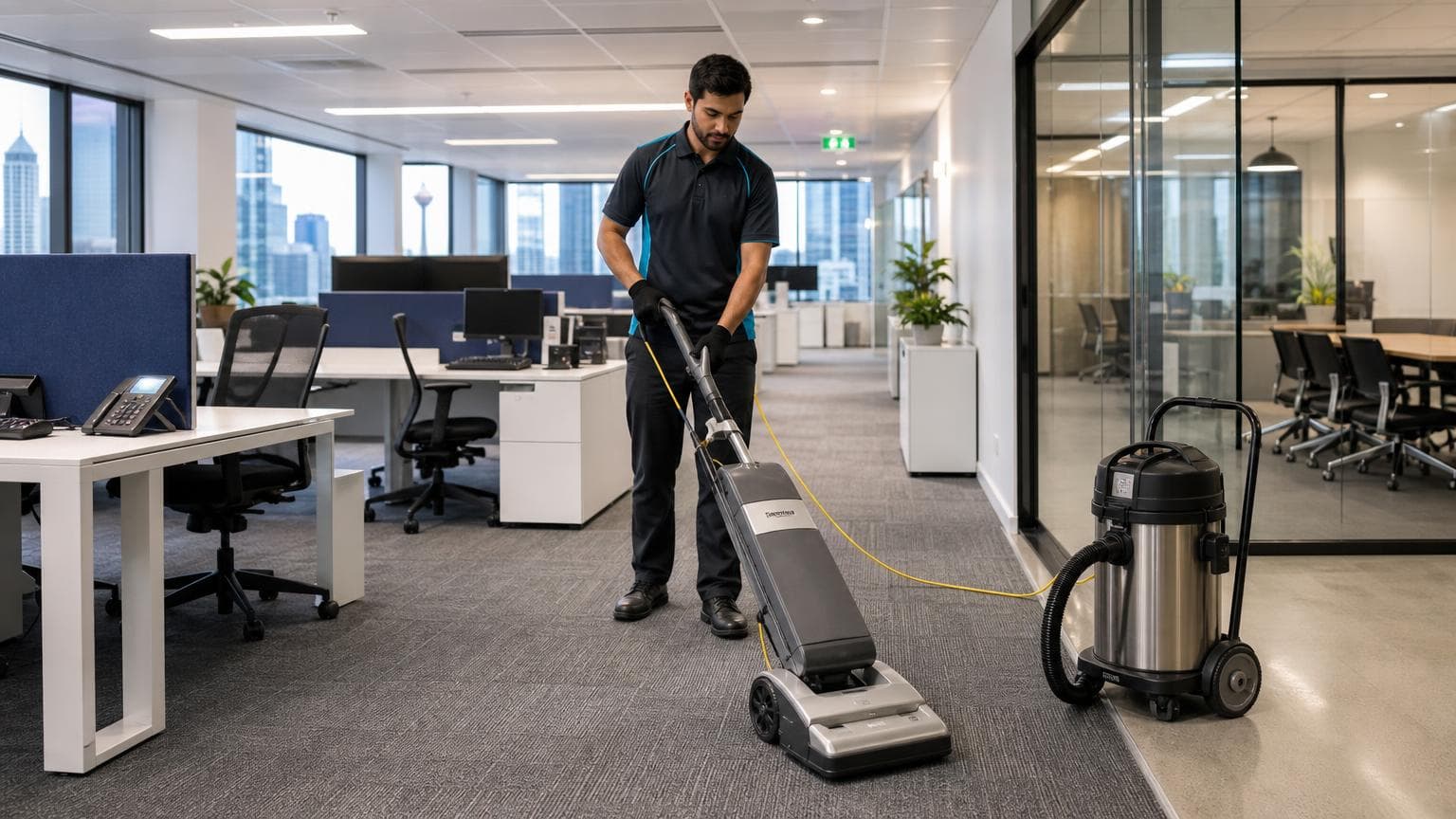
| 3 | Canister | Mixed floors, stairs, edges and occasional detail work | A floor tool and hose that can move between different surfaces | The cleaner manages a separate body and hose during the route |
Only choose battery where the route requires it
Choose battery power only when a cord creates an access, trip-management or occupancy problem. Trace the nearest power point for each cleaning zone and identify where a cord would cross a doorway, aisle or occupied workstation. If power points sit along the route, choose corded equipment rather than adding charging, runtime and spare-battery management. Rank route fit ahead of filtration: confirm filter rating in manufacturer documentation, then compare it with facility requirements. A filter claim cannot compensate for a machine that misses under-desk areas.
Apply the same equipment-selection principle
Start equipment selection with the contamination and surface, then choose a method that cleans without damage. On Eco Spark Facility Services' solar panel cleaning project in Estella, visible dust, bird droppings and leaf residue meant the team needed a non-abrasive, eco-friendly clean followed by a pure-water rinse, rather than a method that could scratch panel coatings or frames.
After cleaning, the glass was clearer and sunlight access across the array was restored. That project does not prove which vacuum is right for an office, and it should not be used as vacuum performance evidence. It does show why cleaning teams should identify the contamination, surface and access constraints before choosing equipment.
Apply the same sequence to an office. Walk the route at the time cleaning will happen, note desk density, floor transitions, stairs, storage areas and power-point access, then select the vacuum type. Most buyers start with maximum suction. That is backwards, because a machine that cannot reach under desks or turn around chair bases will not clean the full route efficiently.
Reject the buying mistakes that slow cleaning
The first mistake is treating a commercial vacuum as a generic appliance. An upright used in a crowded workstation area can force repeated repositioning. A backpack used for long, empty carpet runs may add carrying effort without enough mobility benefit to justify it.
The second mistake is buying a vacuum for the main corridor and ignoring the edges of the route. Under-desk zones, chair bases, skirting edges and transition points often determine the right attachment and hose reach. Test those areas before committing to a model.
The third mistake is assuming one vacuum should replace every cleaning method. A vacuum removes dry debris. It does not replace carpet extraction, upholstery cleaning, hard-floor care or the surface-specific exterior methods used for solar panels.
Run a pre-purchase trial on the real route
- Map the route. Separate open carpet, desk clusters, hard floors, stairs and detail areas.
- Name the main constraint. Choose the one issue that causes the most lost time: furniture density, cord access, stairs, mixed surfaces or dust control requirements.
- Rule out the poor fit. Remove upright models if most of the route sits beneath or between furniture. Remove backpack models if the route is largely unobstructed carpet and the carrying load adds no benefit.
- Test a real cleaning zone. Assess turning space, floor-head access, cord management, noise during the planned cleaning window and emptying method.
- Document the decision. Record the floor types, required attachments, filter documentation and the route the vacuum must complete. This makes replacement purchases more consistent.
This method will not solve a site-specific safety rule, a manufacturer servicing issue or a facility requirement for a particular filtration standard. Confirm those requirements before purchase, especially where a healthcare clinic, school or shared office has its own cleaning specification.
Keep NSW location separate from the selection decision
Office layout should decide the vacuum category, not postcode. The same route-first assessment applies across Sydney, Greater Sydney, Wagga Wagga, Estella and Regional NSW. Estella sits in Eco Spark Facility Services' regular Wagga Wagga and Riverina service area, where the business has observed agricultural dust exposure on solar arrays.
That observation is relevant to exterior maintenance, not a reason to assume every office has the same dust load. Inspect the premises and set the cleaning scope from what is present. For facilities comparing outsourced cleaning rather than buying equipment, review Commercial Industrial Cleaning in Wagga Wagga, Commercial Cleaning Wagga Wagga NSW and Office Cleaning Services Wagga Wagga NSW.
Decide whether to buy equipment or outsource
A vacuum purchase suits organisations that manage their own cleaning route and can test equipment in the real workspace. If the priority is a documented commercial cleaning scope instead, Eco Spark Facility Services provides eco-friendly commercial, industrial and specialised cleaning across NSW. See Commercial Cleaning Services Wagga Wagga or Commercial Cleaning Services Wagga for service context.