Compare Commercial Vacuums for Office Cleaning
A commercial office vacuum should match the cleaning route, not simply the most familiar machine type. Compare backpack, canister and upright models against desks, edges, floor transitions and access conditions.
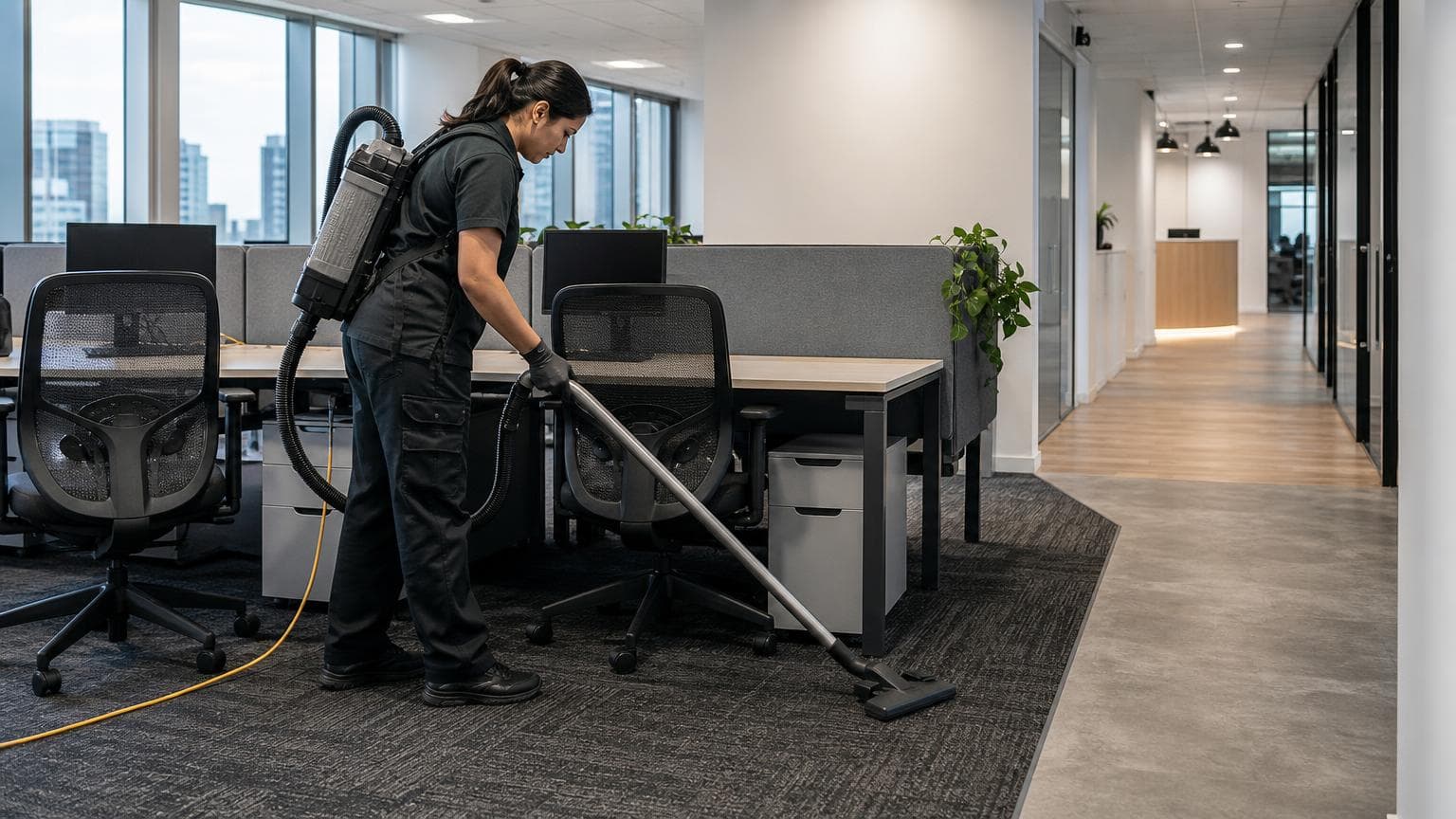
Commercial Office Vacuum Comparison by Cleaning Task
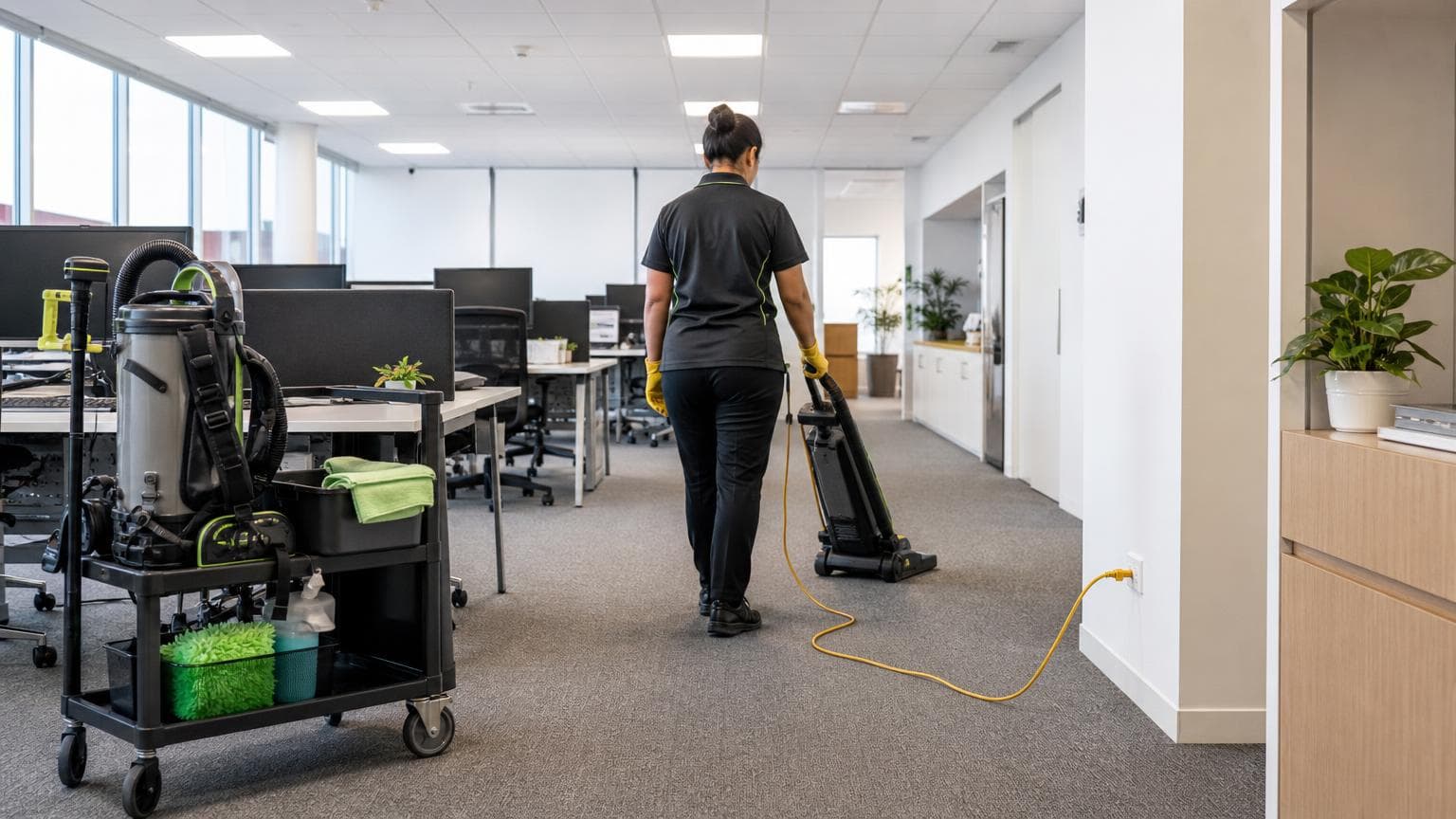
For a furnished office, start with a corded backpack vacuum. It lets a cleaner keep the motor on their back while using a floor tool beneath desk banks, around chair bases and along corridors. Choose a canister when stairs, skirting lines or frequent carpet-to-hard-floor changes dominate the route. An upright belongs in a largely clear carpeted area, not as the default office choice.
Compare models against the cleaning route
Test the actual route before comparing specifications. Walk from the storage point to a desk cluster, a corridor, a carpet-to-hard-floor threshold, skirting and reception edges. Reject a model if its hose cannot reach beneath the desks, its cord must cross an occupied walkway or its floor tool leaves edge debris. A larger motor will not solve any of those access failures.
| Vacuum type | Best office task | Main cost or compromise |
|---|---|---|
| Corded backpack | Desk clusters, chair bases, corridors and regular after-hours cleaning | The operator carries the unit and must manage the cord carefully |
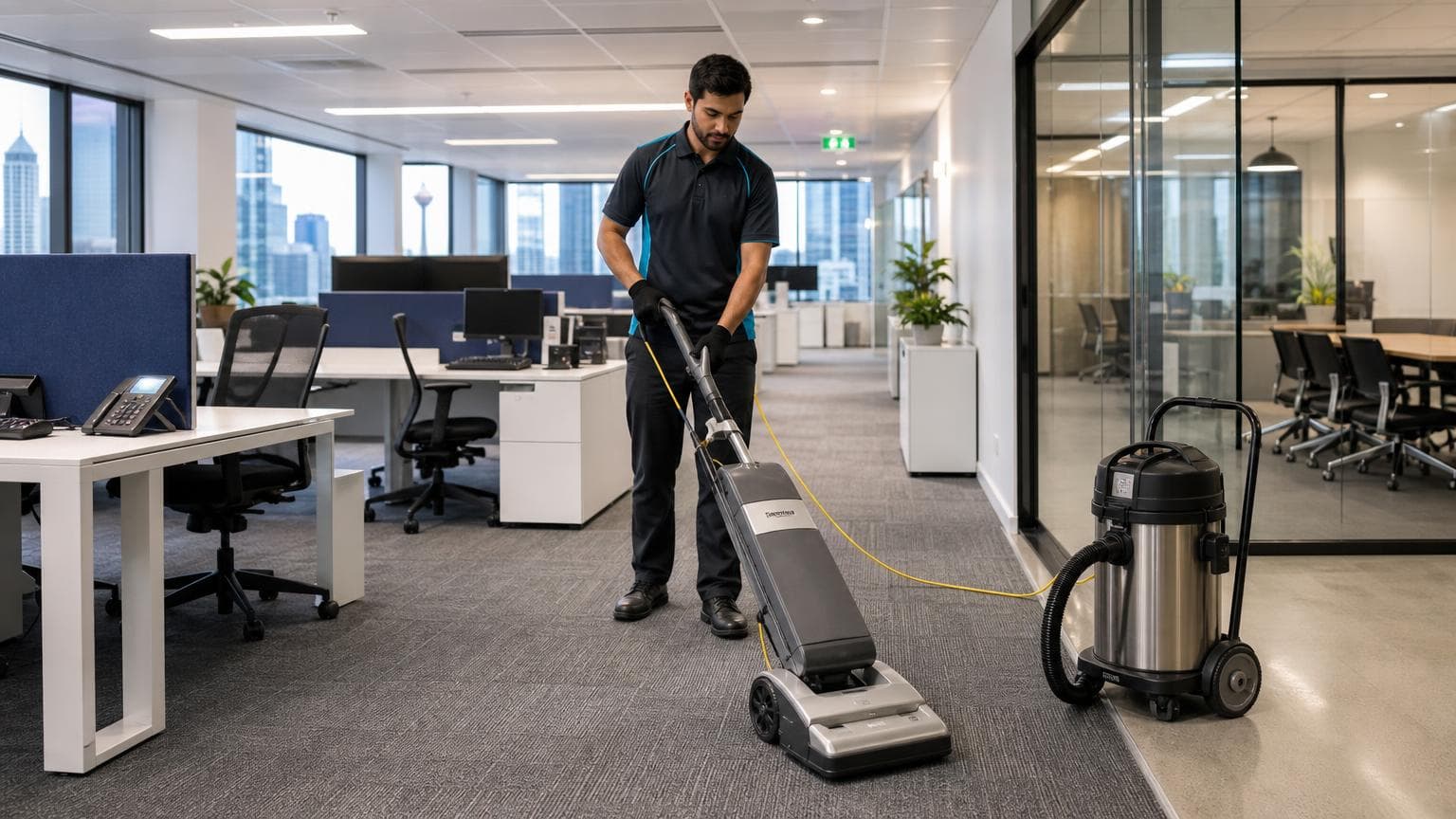
| Canister | Edges, stairs, reception areas and mixed surfaces that need a flexible tool | More body movement and hose management during large open-area cleaning |
| Upright | Broad, open carpeted areas with few obstacles | Less practical around workstations, narrow gaps and complex furniture |
For a furnished office, rank a corded backpack first, a canister second and an upright third. Reverse that order only where the scheduled route is broad, uninterrupted carpet with no desk banks, such as an open training room or empty tenancy. An upright covers that carpet efficiently, but sacrifices access around workstations, chair bases and narrow gaps.
Do not pay for extra features before checking the route. Map where the cleaner starts, the floor transitions they cross, the furniture they work around and the time the office remains occupied. That simple test exposes a mismatch that a product specification sheet will not.
Put the front-runner through an on-site trial
Run the proposed vacuum through one representative section of the premises before committing. Include a desk cluster, a corridor, a carpet edge, a hard-floor transition and any stair or reception area that forms part of the normal cleaning scope.
- Set the route. Identify the surfaces and obstacles the cleaner faces on every scheduled visit.
- Check access. Confirm where a cord can run without crossing an occupied walkway and where the machine can be stored between shifts.
- Test the working position. A cleaner should reach under desks and around chair legs without dragging the machine into furniture.
- Check the finish. Look for debris left at edges, around skirting and at the change between carpet and hard flooring.
This advice will not settle a purchase where hard-floor scrubbing or carpet extraction, rather than vacuuming, does the main cleaning work. Those jobs need a separate equipment decision.
Match the equipment to the surface
Eco Spark Facility Services applies the same surface-first principle in specialised cleaning. On Solar Panel Cleaning Project 1 in Estella NSW, the array had visible dust, bird droppings and leaf residue. The work used a non-abrasive, eco-friendly clean and a pure-water rinse so the panel coatings and frames were not scratched.
After cleaning, the glass was clearer and sunlight access across the array was restored. A solar array is not an office carpet, and this project does not prove that one vacuum type suits every workplace. It does show why the cleaning method must fit the surface and the contamination, rather than relying on force or a generic equipment choice.
Apply that standard to an office vacuum. For example, choose the tool that reaches beneath workstations and controls dust on the relevant floor type, rather than buying an upright simply because it appears faster over an open carpet.
Two purchase mistakes that create a poor office fit
Mistake one: treating an upright as the benchmark. Most buyers begin with the familiar upright shape. That is backwards in a furnished office, because the hardest part of the route is often the space around desks, chairs and edges, not the open carpet in the middle of a room.
Mistake two: separating the vacuum decision from the cleaning scope. A machine that suits an empty tenancy may be a poor fit for an occupied office cleaned around staff schedules. Check the work area, access conditions and storage location before comparing purchase prices.
NSW premises and the agreed cleaning scope
Cleaning conditions and building layouts vary across Sydney, Wagga Wagga, Estella and regional NSW. The relevant local question is not the postcode on the vacuum box. It is whether the equipment suits the actual premises, including office density, access paths, cleaning hours and the surfaces in the agreed scope.
Estella sits within Eco Spark Facility Services' regular Wagga Wagga and Riverina service area. The Estella solar panel project also reflects a regional condition worth recognising in exterior work: agricultural dust and organic buildup can collect on exposed surfaces. Office equipment selection still needs a site-specific route test rather than an assumption based on location alone.
Services that affect equipment choice
If the vacuum decision forms part of a broader cleaning review, compare it against the work included in Commercial Industrial Cleaning in Wagga Wagga. You can also review Commercial Cleaning Services Wagga Wagga, Commercial Cleaning Services Wagga, Commercial Cleaning Wagga Wagga NSW and Office Cleaning Services Wagga Wagga NSW when assessing the work that equipment needs to support.
Get a cleaning-scope quote
If you are comparing an in-house purchase with a contracted cleaning scope, request a quote from Eco Spark Facility Services and include your floor surfaces, cleaning hours and building access.